
-
Services
- PLAN
- BUILD
- SCALE
-
Products
- Automatic Tagging
- Search & Discovery
- Content Moderation
- Case studies
- Company
- Blog
- Pricing
- Let's talk
Case Study
Company |
Industry |
 |
Energy & Sustainability |
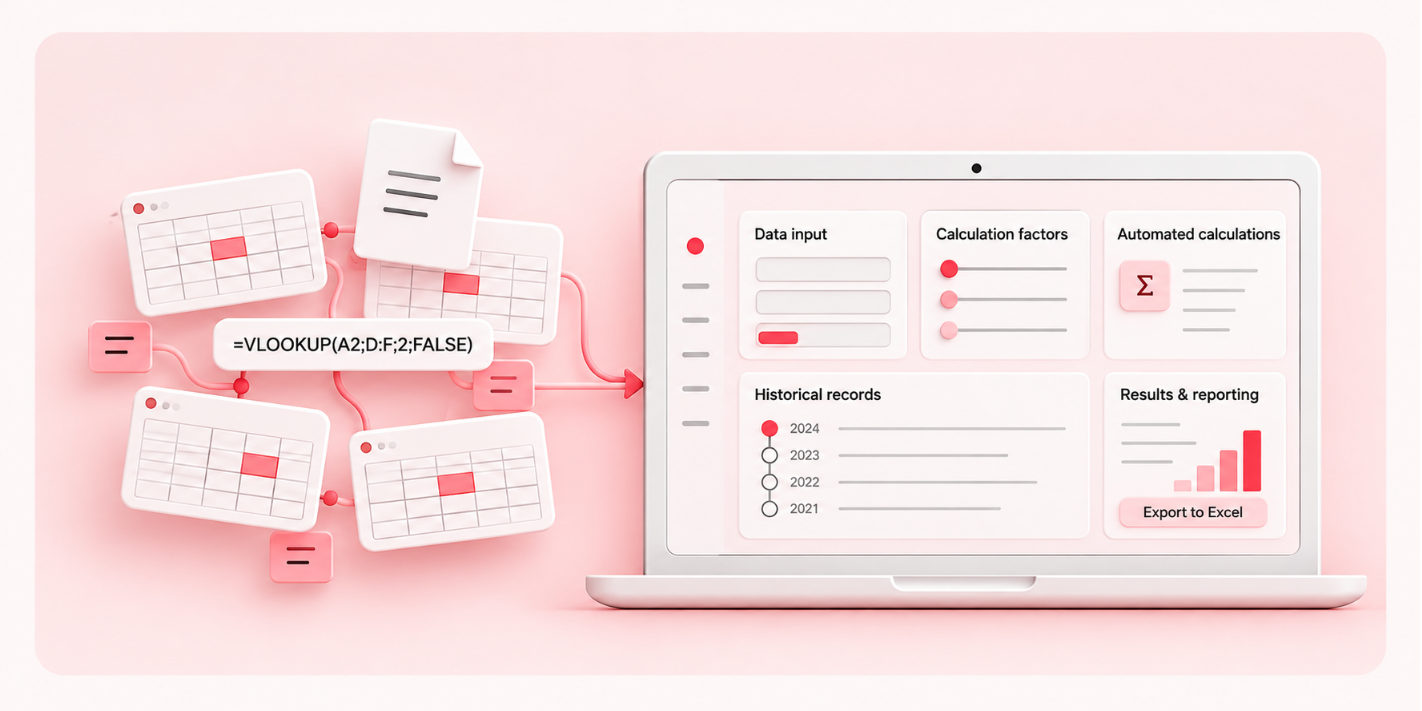

The client is a leading Croatian consulting and engineering company specializing in energy, environmental protection and sustainable development. Its work involves complex calculations and reporting across multiple sectors, requiring teams to manage large volumes of data and ensure accurate and traceable results.

The client replaced a fragmented, Excel-heavy workflow with a centralized web application for data management, automated calculations and reporting.
What changed?

The client relied on a large number of interconnected Excel spreadsheets to collect data and perform complex calculations. Over time, the process had become difficult to navigate, with different employees maintaining spreadsheets in their own way and only a few people having a complete understanding of how the different parts of the process connected.
Data was frequently copied manually between files, creating repetitive work and opportunities for errors. Some calculations that could be automated were still performed manually, with one process taking around five days.
The lack of structure also made historical reporting difficult. When the client needed to explain how a particular figure had been calculated several years earlier, finding the relevant data and calculation logic could be extremely challenging.
This also made onboarding new team members more demanding, as understanding the existing workflow required significant time and knowledge of how the individual spreadsheets were connected.


The Velebit AI team needed to understand the client’s calculations and workflows before translating them into a web application. This required close collaboration with domain experts who were not software developers, including regular meetings, reviews of individual calculations, and continuous feedback. The goal was not simply to digitize the existing spreadsheets, but to understand the underlying process and create a system that would support the people using it.
The system needed to support approximately 5,000 calculations and allow additional sectors to be introduced without fundamentally changing the application.
Calculation factors can change over time. The system therefore needed to preserve the inputs and factors used at a particular point in time, allowing historical results to be traced and reproduced.
The application had to support the functionality previously spread across dozens of Excel files while remaining simple enough for users accustomed to spreadsheet-based workflows. The challenge was to make the process easier without taking away the flexibility and domain knowledge users had built into their existing workflows.

Velebit AI developed a custom web application that centralizes the client’s data, calculations, and reporting workflow.
Users can enter and manage data systematically, while calculations are performed automatically in the background. The application also generates the required Excel tables, allowing the client to continue submitting data through its existing external reporting platform.
A PostgreSQL database provides a structured foundation for storing the data and calculation history. Versioning of calculation factors and inputs makes it possible to understand how a result was calculated at a specific point in time, even when the underlying factors have since changed.
The solution was developed from scratch because the existing external reporting platform did not provide the functionality or user experience the client needed. A custom application allowed the workflow to be designed around the client’s specific processes while providing a foundation for future expansion.
The project followed an iterative approach, with an initial solution proposed early in the engagement and a working prototype presented after approximately two months. Regular communication and feedback from domain experts helped the team refine the application and ensure it reflected the client’s real-world workflow.
 Python
 FastAPI
 PostgreSQL
 HTML
HTML
 CSS
CSS

We delivered a fully custom web application that brings the client’s complex calculations, data, and reporting workflow into one structured system. A process that previously required around five days of manual work can now be automated, reducing repetitive data entry and the risk of errors.
Historical calculations can be traced and reproduced, while calculation logic is no longer confined to individual spreadsheets and is easier to share across the team.
The result is a more reliable, scalable way of working, which gave employees less time spent managing complex spreadsheets and more time to focus on the expertise behind the process.